
The Non-Linear Path
Direct conversation, forced distance, and a new way to see structure.

Where was I? Back in August, I got back my first results from a Black List evaluation (and when I say “first”, I mean it was my first time ever submitting a script to TBL, a goal of mine for some time now). Details on those notes can be found here, but in short, I landed a 7 on my first review. I spent the month following that first evaluation addressing the notes, pushing myself to turn in a revised script for a second evaluation by October. My overall goal was to try to push the 7 to an 8 by tightening up the first act.


I submitted the revised draft and settled in to wait. The first evaluation had taken several weeks to come through, so I expected a similar wait time. However, this time, the evaluation came back in days.
Overall score: 5.
With the dialogue score dropping from an 8 to… a 3.
Not exactly what I had been going for.
With a swing that dramatic, I figured I had better connect with someone I trusted for feedback, so I reached out to Joslyn Jensen and Frank Mosley of Script Eater (they are unique in their perspective and advice in that they both are not only avid readers of screenplays by trade, but also themselves writers, producers, directors, and actors). I wasn’t only looking for further coverage of the script, I realized I needed something I couldn’t get with The Black List: a direct one-on-one conversation.
I left the call feeling an incredible focus and energy that I couldn’t wait to put towards a new draft of the script. But then —
A project came along (via my day job). A very large project. One that was going to require two months of late nights, stressful research and testing, collaboration with contractors, etc. The kind of project that wasn’t going to leave much for me to work with (creatively) at the end of the day. I knew if I tried to push ahead with the script while doing this larger project, I would fall short on both fronts.
So I made a choice.
I took the print-off of the script and sat it by my bedside.
I never picked it up to read it during those two months, but it was there every night as I leaned over to turn off the light. I couldn’t anticipate if the forced time away was going to be a benefit, but I was going to make sure it wouldn’t result in a dead end.
On the drive to and from the office, I would record voice notes if an idea or a question came up related to the film. It’s important to have systems in place where you can quickly set aside ideas and feel safe that they won’t get lost in the mix when you’re ready to return. I find if I can’t get an idea down somewhere that I know is safe, that idea will just keep looping and make it hard to concentrate on anything else.
The weeks passed by slowly, and finally, the day job project launched.
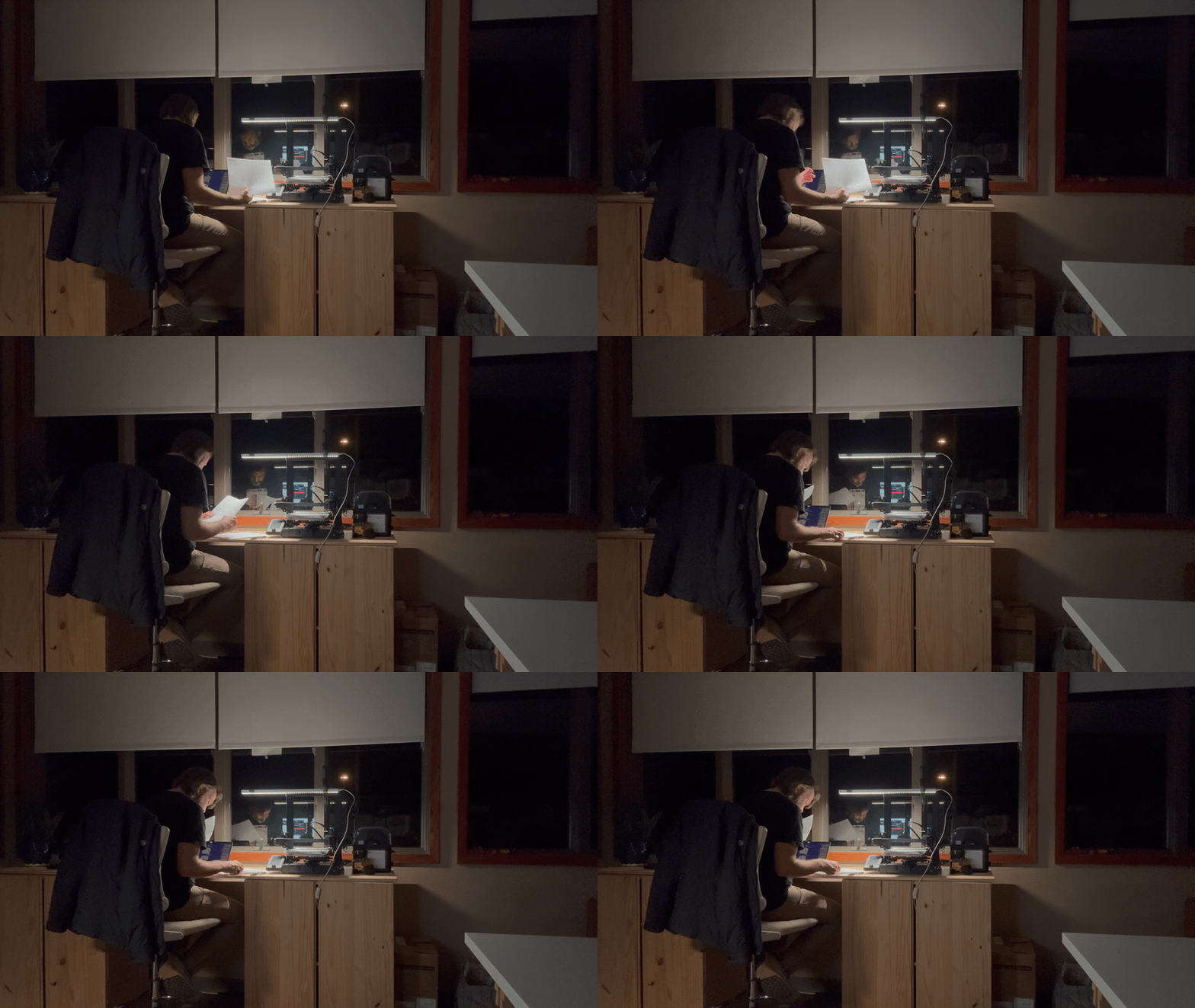
Work eased enough that I could leave the office and still have the mental energy to jump back into writing. But I knew I couldn’t just pick up where I left off. I needed a new approach to properly address the collection of notes from Script Eater and The Black List.
INT./EXT.
Normally, with scripts, momentum is easy to see: scenes change location every 2-4 pages, giving you natural breaks and shifts. But with this film, the characters are locked in one room for 90% of the story, meaning that transition-pace or momentum was blurry. I couldn’t rely on the usual structural landmarks.
So I grabbed a handful of colored Sharpies and began to track the starts and stops of arguments the characters were dealing with.


Green brackets tracked one thread, red another (in this story, it’s not uncommon for two overlapping and staggered arguments to occur within the same few pages).
Suddenly, I could see the rhythm of the film in a way that was blurry before. This approach helped me discover a sequence in the middle that ran roughly 12 pages from intro to point-of-no-return. Even though it was intercut with other dilemmas, it was the slowest beat by far. That one discovery opened up everything. The process of turning those 12 pages into 5 helped profoundly shift the weakest part of the script.
Over about three weeks of focused work—with one final push of 15 hours across three nights—I got the script down to 111 pages. It moves like a bat out of hell now.
Next Steps
Coincidentally, a few feelers that I had put out months ago circled back just as I was wrapping up, and I was able to send this version to a team I’d written for on another project—people who know my work. In the meantime, I’ll be sharing the script for another Black List evaluation to see where things land after these rewrites. I don’t know what either will bring back, but the script is tighter, the arguments sharper, and I can see the architecture in a way I couldn’t before.
Sometimes the path forward isn’t linear. Sometimes you need distance (or to make the most of forced distance), new tools, and a willingness to see the same material from a new perspective. On a related note —
The time away helped spark an idea for a new short film (set in the same universe as the original short film that played at SBIFF). The new idea resulted in a six-page story, one location, written in a single night. More on that soon.
Speaking of, if you’ve never seen the original short film 🍿
Putting a script aside for a while is the best possible thing for coming back to it with clearer vision and less attachment. Love that you homed in on what was happening exactly and identified a week sequence. Yay, you.